Why there is no price per foot
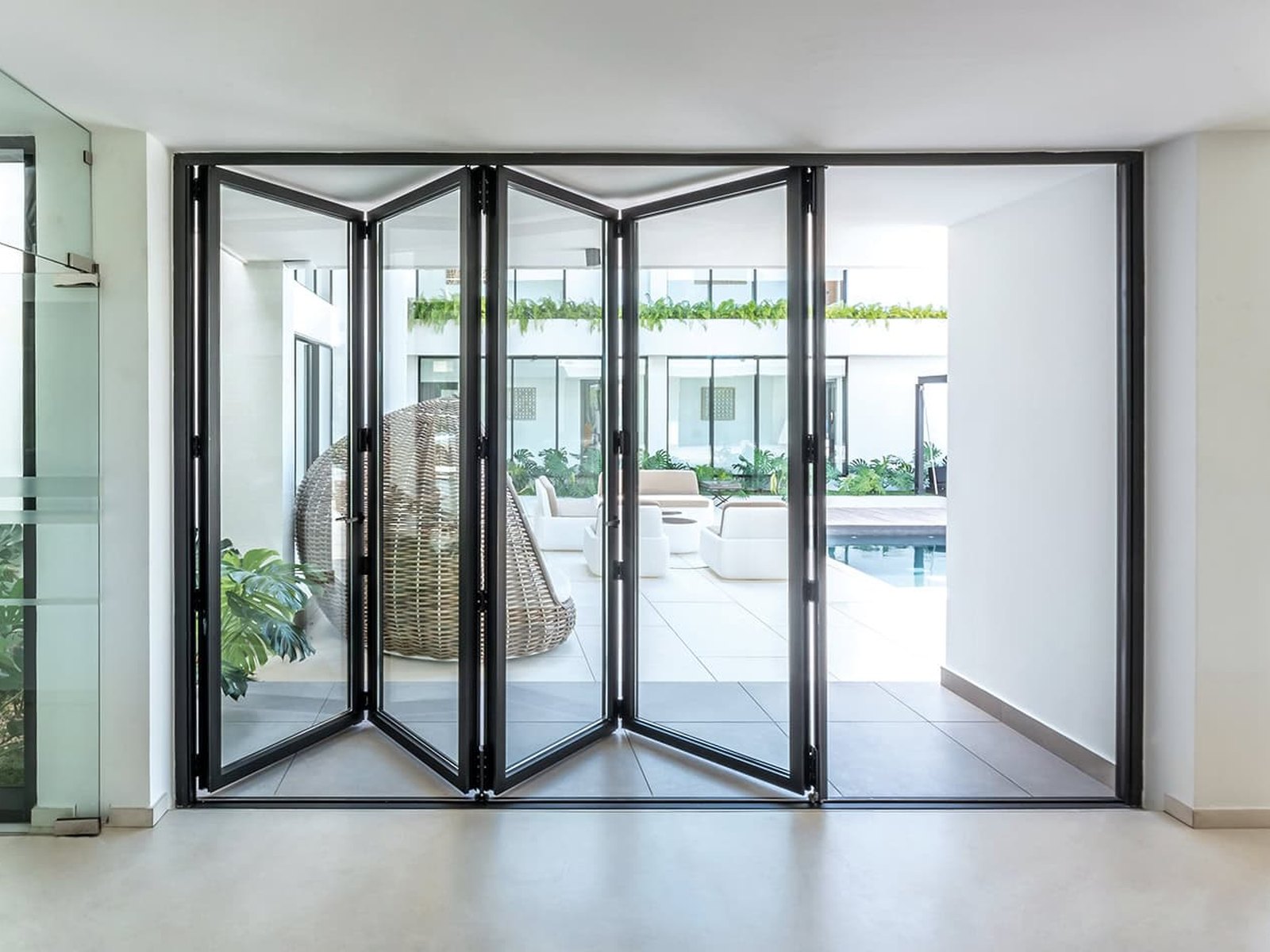
The useful way to think about a folding door is that every leaf is a complete door. Each one has its own frame, its own hinges, its own sealed glass unit, its own hardware and its own set of adjustments on site. A ten-leaf opening is ten doors that have to stay in line with one another for the next twenty years.
That is why a per-foot figure means nothing here, and why the same nominal width can differ enormously in cost depending on how it is split. It is also the honest reason nobody in this trade publishes a price: without seeing the opening, the split, the glass and what is above it, any number quoted is a lead-generation tactic rather than an estimate.
The rest of this page is the useful version — what actually moves the figure, in roughly the order it moves it.
What actually moves the number
1. How many leaves, and how wide each one is
Our folding system takes leaves up to 3 ft 11 in wide and 10 ft tall, at up to 265 lb each, with up to fourteen in a single opening. Between those limits there is a real trade-off. Fewer, wider leaves mean less hardware and fewer frames to look at when the door is closed, but each leaf gets heavier and the glass unit gets disproportionately more expensive as it grows. More, narrower leaves is usually the cheaper way to cover the same opening, and the stack is easier to live with.
If budget is the binding constraint, changing the split is normally the cheapest change you can make. It is also one of the few changes that costs nothing to discuss before the order and a great deal after it.
2. The glass
Every metro we work in sits in Climate Zone 2A, where the energy code caps solar heat gain coefficient at 0.25. That is a binding constraint rather than a target, so a solar-control low-E coating is not an upgrade you can decline — it is the thing that makes the opening legal.
Glass matters more on a folding door than on a slider, for a reason that is easy to miss: a folding wall has far more glass edge per square foot of opening. More units means more perimeter, more edge seal and more spacer. Move up to laminated glass for acoustics or security, or towards the top of our 1″ to 1¾″ glazing range, and the glass can quietly become the largest single line in the quote.
3. The threshold
This is the folding-door-specific one, and it is the item that most often separates two quotes that look otherwise identical. A weathered threshold — a low upstand you step over — is the cheaper option and the more forgiving one in weather. A flush, step-free threshold, level from inside to out, is what almost everyone actually wants, and it costs more because the drainage has to be designed into the floor build-up rather than added afterwards.
On new build that is a coordination job. On a retrofit it can mean cutting into the slab. Either way it is a design-stage decision, not something you add later at any price, so decide it before you compare quotes and make sure both quotes assume the same thing.
4. What is above the opening
The expensive surprises are structural. A wide opening needs a beam that does not deflect under load, because a head that moves will bind a folding door — and a run of hinged leaves shows up head movement faster than a slider does. On new build we issue our maximum permissible head deflection at design stage so the engineer can size for it. On a retrofit, establishing what is above the opening is the single most useful thing you can do before falling in love with a configuration.
5. Fold direction, stacking and the traffic door
Which way the leaves fold, which end they stack at, and whether they split from the middle all change the hardware and the price. Folding outward keeps the stack off your floor but needs clear space outside; folding inward is the opposite bargain. The wall to the side of the opening has to be free to take the stack, which on a retrofit is occasionally the thing that decides the whole configuration.
The end leaf hinged as an everyday traffic door is standard on our system, so you step through one leaf without folding the whole set back. On some systems it is a cost option — worth confirming, because it changes how you live with the door far more than any spec on the sheet.
6. Finish, locking and hardware
Powder-coat finish, a different color inside from outside, and handle choice all move the number modestly. Locking moves it more. Multi-point locking on the primary leaves and shoot-bolts on every intermediate leaf come as standard here rather than as an upgrade; on other systems they are separate lines. Two quotes are not comparable until you know which.
7. Access and installation
A folding leaf tops out at 265 lb, against 705 lb for a large sliding panel. Individually lighter units are genuinely easier to get into a difficult site, so on a tight urban lot or a steep Austin hillside a folding door can avoid the lifting equipment a big slider would need. That is a real cost advantage, and one that only shows up if the supplier has actually looked at the access.
Is a bifold cheaper than a sliding door?
Not reliably, and the honest answer is that the difference is smaller and less predictable than people expect. A folding door carries more hardware per foot of opening — hinges, shoot-bolts, a running gear set per leaf. A sliding door carries fewer, larger, heavier panels, and both the glass and the rollers get expensive as panel size grows. Which one wins on price depends on where your opening falls between those curves.
So choose on how you want to use the opening instead. A folding door clears almost the entire wall, at the cost of a stack of panels to one side and a frame every few feet when it is closed. A slider keeps an uninterrupted view through a ¾-inch meeting stile, at the cost of half the opening staying glazed. We set that comparison out properly in the guide to choosing between them.
Why a stock quote is not comparable
A stock folding door in a standard size and a fixed configuration, dropped into an unchanged opening, is a different product from a made-to-measure thermally broken aluminum system spanning a wall. Neither is dishonest; they are just not the same thing, and comparing the two numbers tells you nothing.
If you are comparing quotes, make both of them describe the same job. Ask each supplier, in writing:
- The system by name and manufacturer — not just "aluminum"
- The maximum leaf size and leaf weight the system is rated for
- The glazing thickness range, and the U-factor and SHGC of the make-up being quoted for your project rather than the system best case
- Whether the threshold is weathered or flush, and who is responsible for the drainage design
- Whether multi-point locking and shoot-bolts on the intermediate leaves are included or extra
- Who performs the installation — the supplier’s own team, or a subcontracted crew
- What happens when the door needs adjusting in year two, and who you call
The last one matters more on a folding door than on anything else we make. A run of hinged leaves settles, and at some point it will want adjusting; that is normal and it takes an hour if the person doing it fitted it in the first place. A quote that is cheaper because installation was subcontracted has not saved you money, it has moved a risk onto you and taken it off the page.
Replacing a slider with a folding door
This is a common request and usually possible, but three things decide it. What is above the opening, because the header now has to satisfy the deflection limit for a folding door. The floor, if you want the flush threshold. And the wall beside the opening, because the leaves have to stack somewhere.
All three are answerable from a survey, and none of them are answerable from a photograph alone. If the existing frame is sound and only a sealed unit has failed, replacing glass is far cheaper than replacing the system — we will tell you which situation you are in. The patio door replacement page covers what that job involves.
What to do next
Send rough dimensions, a photograph of the opening, which side you would want the leaves to stack, and whether a flush threshold matters to you. That is genuinely enough to begin, and you will get a real figure from the people who fabricate and install these rather than a brochure and a follow-up call.